PILLAR I · OWNERSHIP
Own it.
A lifetime license is $2,499. Host it on your cluster, your laptop, or an air-gapped VPC. Bring your own keys. Keep your own audit logs. We never sit between you and your data.
CHAPTER I·THE GATE
Gatewyse routes your traffic across every major AI provider with intelligent free-tier chaining, cryptographic audit trails, and a lifetime license you actually own.
CHAPTER II·THE THREE PILLARS
PILLAR I · OWNERSHIP
A lifetime license is $2,499. Host it on your cluster, your laptop, or an air-gapped VPC. Bring your own keys. Keep your own audit logs. We never sit between you and your data.
PILLAR II · JUDGMENT
Eleven routing strategies, including free-tier chaining that exhausts every provider's free quota before touching a paid key, least-cost, least-latency, failover, weighted, ML-driven task-optimized routing, and a review panel that asks several models at once and synthesises their answers.
PILLAR III · VIGILANCE
SHA-256 hash-chained immutable logs you can verify yourself. Argon2id for passwords. AES-256-GCM with scope-bound AAD on every stored credential. Fourteen guard types. SOC 2-ready by construction.
CHAPTER III·THE JUDGMENT
Ten of them order the providers into a chain and walk it: Gatewyse checks health, cost, latency, and free-tier balance, and when a provider's quota exhausts or its circuit opens, the gate passes judgment to the next candidate without dropping a packet. The eleventh, review panel, refuses to pick — it puts the question to every model at the top priority level at once and has a synthesizer write the answer they agree on.
CHAPTER IV·THE MODALITIES
Thirteen modalities and surfaces. One API key. Route by task, cost, latency, or free-tier balance — the gate decides.
POST /v1/chat/completions
OpenAI-compatible chat with streaming, tool use, and vision.
Providers
curl https://api.gatewyse.com/v1/chat/completions \
  -H "Authorization: Bearer $GATEWYSE_KEY" \
  -H "Content-Type: application/json" \
  -d '{
    "model": "gpt-4o",
    "messages": [{"role":"user","content":"Explain routing strategies in one line"}],
    "stream": true
  }'
CHAPTER V·THE VIGILANCE
Six laws of the gate. Each one verifiable in code, hardened against the threats that actually matter for an AI gateway: credential exfiltration, audit tampering, provider compromise, and cascading failure.
Every log entry is sha256(entry ‖ previousHash). Verification recomputes each entry's hash from the record it covers as well as checking the links, so editing a row in place is caught, not just deleting or reordering one — and you run the pass yourself from the admin console. Append-only. Sequence numbers prevent reordering. TTL indexes enforce 365-day retention by default.
The only password hash we accept. No bcrypt. No SHA-family. Memory-hard by design, resistant to GPU and ASIC attacks. Cost parameters per deployment; defaults exceed OWASP 2024 recommendations.
Provider API keys are encrypted at rest. An override's scope — the organization or department that owns it — is bound in as additional authenticated data, so a ciphertext lifted from one department's credentials will not decrypt under another's. Ciphertext is version-prefixed for rotation.
Fourteen guard types run on every request and response: regex PII detectors (SSN, credit card, email, phone, IP, API key), jailbreak and prompt-injection detection, secrets detection, topic and keyword filters, token, rate and cost limits. Toxicity and PII additionally run a local ONNX model — in-process, never an outbound call to a moderation API. Actions: block, redact, mask, or hash.
Okta, Microsoft Entra, Google, and any OIDC/SAML provider. Each organization points at its own identity provider and claims its own domains, so two organizations in one deployment never share a session or a directory. A deployment-wide config is the fallback for the ones that do not.
Each provider runs behind a per-instance state machine. After 5 consecutive failures, the circuit opens; routing skips it for 60 seconds; a half-open probe then closes it on success or re-opens on failure. No cascading failures under provider outages.
CHAPTER VI·THE CASCADE
Providers and models cascade from the deployment catalogue down to an organization, and from an organization down to a department, by sparse patch. Each level changes only the fields it names and inherits everything else. Nobody clones a configuration to change one line of it.
BASE
Every provider the deployment knows how to reach, and every model on it, live in one catalogue. Mutating it requires deployment scope, so a catalogue entry is not something a business unit can quietly rewrite for everyone — and no organization can add a provider the deployment does not have.
ORGANIZATION
An organization patches a catalogue entry rather than copying it: its own credential, base URL, rate limits, priority, and which models it withdraws or takes up. It points at its own identity provider and claims its own email domains. Reads and writes are bounded by scope, and a refusal is written to the audit trail.
DEPARTMENT
A department patches its organization's resolved view the same way. Absent is not false — a field you never set keeps tracking the level above, so rotating a key or repricing a model at the top reaches everyone who did not override it, and the ones who did keep what they chose.
And the credentials do not travel with them. The scope that owns an override is bound into its ciphertext as additional authenticated data, so a key one department set will not decrypt in another's context.
CHAPTER VII·THE COMMAND
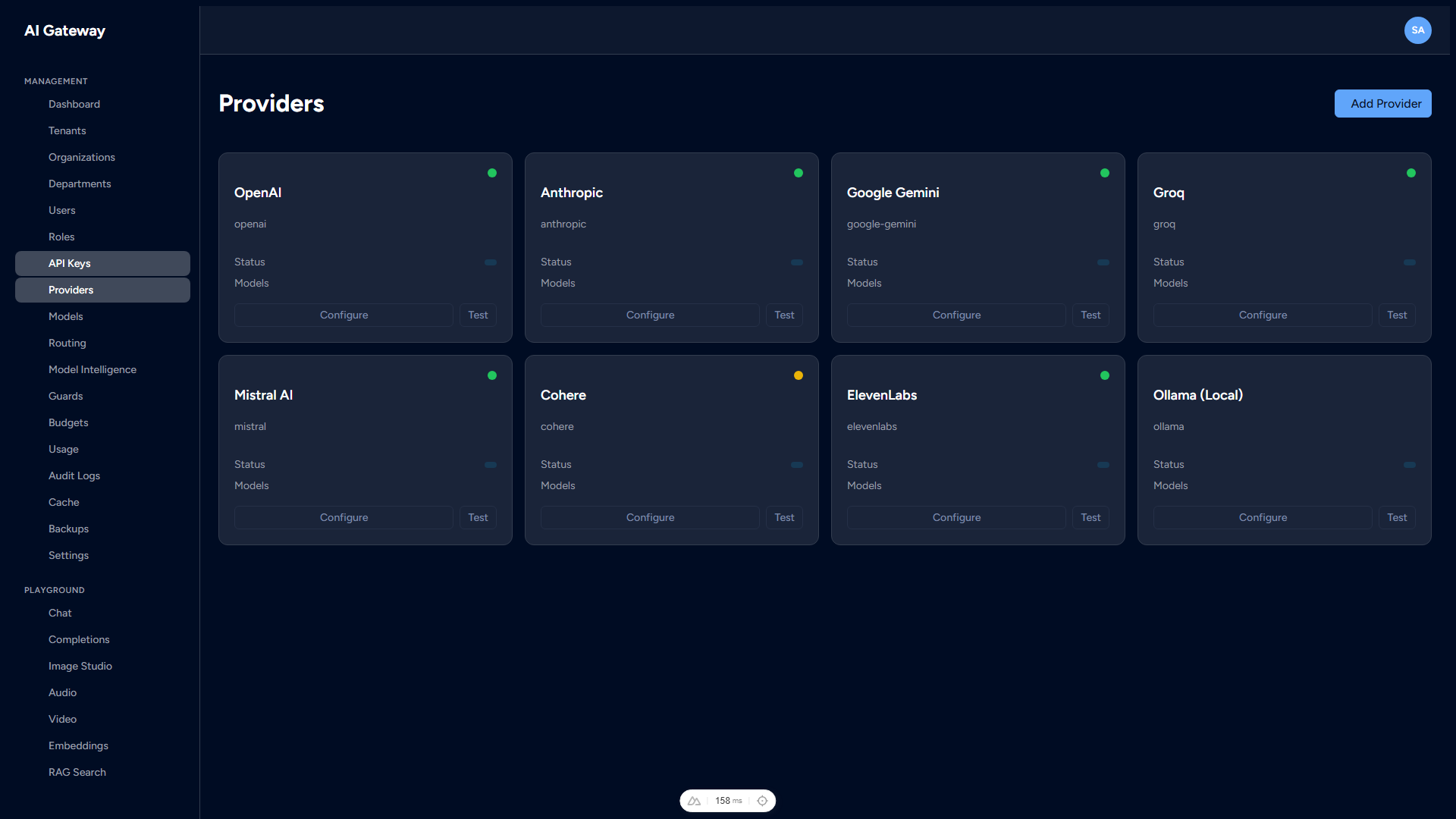
Operators see every decision the gate makes. Configure providers, compose routing chains, audit every action, and live-test modalities.
CHAPTER VIII·THE SOVEREIGNTY
Most platforms rent their gate to you forever. Gatewyse gives you two honest options — own it outright, or amortize the license through a managed deployment and keep it when you're done.
STARTER · PERPETUAL
$2,499once
MANAGED · DEDICATED
$99/mo
Single-node k3s deployment we run for you. Infrastructure and license amortized into one monthly bill.
See managed pricingCHAPTER IX·THE QUESTIONS